

Radio Taiso in Japan: A Beginner's Guide to Group Exercise
Radio calisthenics in Japan-known as Radio Taiso or Rajio Taisō-is one of the world's simplest, most accessible forms of group exercise. For many people in Japan, the music and counting voice are as familiar as a national soundtrack: children in schoolyards, office workers in suits, and older adults in parks all moving in sync to the same three-minute routine.
For anyone interested in everyday wellness, healthy aging, or gentle fitness you can do almost anywhere, Radio Taiso offers a surprisingly powerful model. This guide explains what it is, how it started, what the science says, and how to begin safely-even if you are not in Japan and have never followed a group workout before.
What is Radio Taiso?
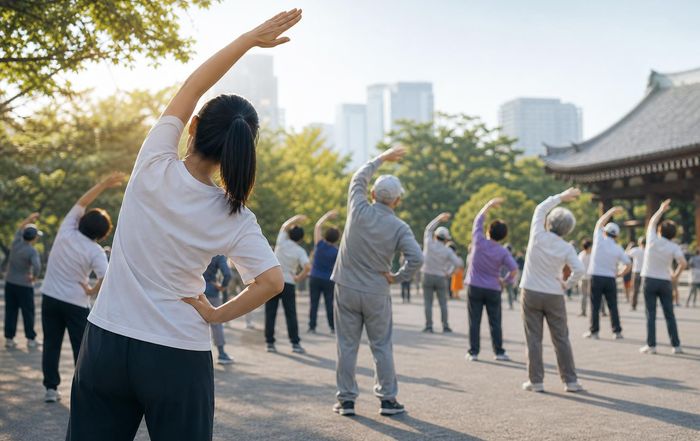
Radio Taiso is a set of short, rhythmic calisthenics routines designed to be performed in groups, traditionally to music and spoken instructions broadcast by radio (and now television and online). The most common routine, often called "Radio Taiso Dai Ichi" (Exercise No. 1), lasts about three minutes and includes a sequence of simple movements: arm swings, side bends, light jumps, trunk twists, and stretches performed in a fixed order. Participants usually stand in rows, follow the same pace, and complete the routine together, often at the start of the day.
The program is overseen in Japan by Japan Post Insurance, which continues to sponsor and promote it as a public health activity. The routines are broadcast daily on NHK, Japan's public broadcaster, and are also demonstrated by trained instructors at community centers, schools, and workplaces. While it may look like a nostalgic ritual, Radio Taiso functions as a structured warm-up: it mobilizes joints, gently elevates heart rate, and encourages better posture and coordination. For many older adults, it is also a convenient way to maintain balance and flexibility without needing a gym membership or special equipment.
Because the movements are standardized and the audio cues are consistent, Radio Taiso has become a shared cultural language of movement. People who learned the exercises as children can often recall them decades later. This familiarity helps encourage participation across generations, which is one reason the practice has become a staple of community wellness and active lifestyle culture in Japan and beyond.
A Brief History: From Public Health Policy to Daily Habit
Radio Taiso has roots in early 20th-century public health campaigns. Inspired partly by group calisthenics programs in the United States, the first Japanese version was introduced in 1928 to commemorate the coronation of Emperor Hirohito. The idea was to create a brief, standardized exercise routine that citizens could perform daily to improve national fitness, especially at a time when modern medicine and organized sports were still developing as mass phenomena.
Over the following decades, the practice spread through schools, companies, and local communities. Morning Radio Taiso sessions became common in factories and offices, in part as a way to reduce workplace injuries and promote camaraderie. After World War II, the program was revised under the guidance of medical and exercise experts to better align with contemporary understanding of physical fitness and to remove overtly militaristic elements. The modern routines emphasize joint mobility, cardiovascular stimulation, and light strength work rather than discipline or drill.
Today, Radio Taiso remains a fixture of Japanese life. In many elementary schools, children still perform it in the schoolyard before class or during sports days. Some companies continue to use it as a daily warm-up, especially in manufacturing and logistics. Community groups, particularly those focused on wellness and healthy aging, organize sessions in parks and public spaces. During summer holidays, neighborhood children in some areas gather early in the morning, collect attendance stamps, and exercise together-a tradition that reinforces both movement and social connection.
The routine has also spread internationally. Japanese communities abroad, language schools, and cultural festivals often feature Radio Taiso demonstrations. Online videos and smartphone apps have made it easier for people worldwide to try the exercises, adapting the original broadcast format to contemporary digital platforms.
What Does a Typical Radio Taiso Routine Include?
Although there are several variants, most beginners encounter two core sequences: Dai Ichi (No. 1) and Dai Ni (No. 2). Dai Ichi is generally considered suitable for almost everyone, including older adults and those returning to movement after a break, while Dai Ni is slightly more vigorous and includes more dynamic and strength-oriented moves.
A standard Dai Ichi routine usually includes the following elements, each performed for only a few seconds before moving on:
Upright posture with deep breathing to prepare the body.
Gentle arm raises and lowers to shoulder or overhead height.
Side stretches and lateral bends to open the ribcage and waist.
Light trunk twists to mobilize the spine.
Forward bends and back extensions within a comfortable range.
Small knee bends or half-squats to activate the legs.
Simple jumping or heel-raising movements to stimulate circulation.
Finishing breaths and relaxed arm swings to cool down.
The movements are synchronized with music and a counting voice, typically structured in sets of eight counts. This rhythmic pattern helps participants maintain a consistent tempo without needing to watch a clock. The choreography is deliberately symmetrical and repetitive so that beginners can follow along after only a few sessions. Many people learn purely by imitation, standing in the back of a group and gradually picking up the sequence.
Because the routine is short and does not require equipment, it can be integrated into other activities. Some people use Radio Taiso as a warm-up before walking, fitness training, or sports; others treat it as a stand-alone daily ritual, similar to brushing teeth or making morning coffee.
Health Benefits: What the Evidence Shows
For a routine that lasts only a few minutes, Radio Taiso has attracted notable research attention, particularly in the context of aging populations and community health. Studies from Japanese universities and medical institutions suggest that regular participation can contribute to improvements in mobility, balance, and cardiovascular health, especially among older adults.
Research published through institutions associated with The University of Tokyo and other Japanese universities has found that structured group exercise programs, including Radio Taiso, are linked with better lower-body strength, walking speed, and functional independence in seniors. While the routine is relatively low intensity compared with vigorous sports, its consistency and accessibility make it easier for people to sustain over months and years, which is critical for long-term health benefits.
Organizations such as the World Health Organization recommend that adults aim for at least 150-300 minutes of moderate-intensity aerobic activity per week, plus muscle-strengthening activities on two or more days. Radio Taiso alone is not usually enough to meet these full guidelines, but it can serve as a practical entry point, especially for those who are sedentary or hesitant about exercise. By gently elevating heart rate and promoting joint movement, it helps reduce stiffness and may lower the barrier to adding more walking, mindfulness practices, or other forms of physical activity.
The social element also matters. Group exercise has been associated with better adherence and improved mental well-being in multiple studies. Regular participation in community programs can help reduce loneliness and support mental health-an area emphasized by organizations such as the U.S. Centers for Disease Control and Prevention and Public Health England (now part of the UK Health Security Agency and Office for Health Improvement and Disparities). For older adults in particular, Radio Taiso gatherings provide a predictable social rhythm and a reason to leave the house, both of which can support cognitive and emotional resilience.
Finally, the routine may have indirect benefits through posture awareness and body coordination. The repeated cues to stand tall, move the arms fully, and coordinate breathing with motion can encourage better alignment throughout the day. For office workers or students who spend long hours sitting, these small daily resets may help counteract some of the physical strain associated with prolonged sedentary behavior.
Why Group Exercise Matters in the Japanese Context
To understand why Radio Taiso has remained so prominent in Japan, it helps to see how it fits into broader cultural and social patterns. Group activities, whether in schools, companies, or neighborhood associations, often play a significant role in Japanese life. Shared rituals help reinforce a sense of belonging and mutual responsibility, and Radio Taiso functions as one such ritual around movement and community lifestyle.
In workplaces, morning calisthenics can serve several purposes: they act as a safety warm-up in physically demanding jobs, signal the start of the workday, and remind employees that health is a shared concern rather than a purely personal matter. Some Japanese companies have reported fewer musculoskeletal injuries and improved morale after instituting regular group warm-ups, though outcomes vary and depend on implementation quality and broader organizational culture.
Schools use Radio Taiso not only to promote physical fitness but also to teach coordination, rhythm, and cooperation. Children learn to move together, follow instructions, and take part in a collective activity without competition. This cooperative framing distinguishes Radio Taiso from many sports, where performance and ranking are central. Here, the goal is participation itself.
At the community level, local governments and health insurers sometimes support Radio Taiso sessions as part of fall-prevention or healthy-aging strategies. Japan's Ministry of Health, Labour and Welfare, along with municipal health departments, has emphasized the value of regular light exercise and social engagement in managing the challenges of an aging population. Radio Taiso is one of several tools used to encourage older adults to stay active, alongside walking groups, low-impact aerobics, and chair-based exercise programs.
Internationally, health agencies such as Health Canada, Australia's Department of Health and Aged Care, and the National Health Service in the UK promote similar messages: consistent, moderate movement integrated into daily life can be as important as occasional intense workouts. Radio Taiso provides a concrete example of how a simple, standardized routine can become woven into the fabric of everyday life.
How to Start Radio Taiso as a Beginner
Beginning Radio Taiso is straightforward, even without Japanese language skills. The movements are visual and repetitive, and many instructors provide demonstrations online. For those outside Japan or without access to a local group, a few practical steps can help:
First, choose a version to follow. The classic Dai Ichi routine is usually the best starting point because it is widely available and designed to be accessible. Many Japanese public-health resources and broadcasters, including NHK, provide demonstrations. Even if the verbal instructions are in Japanese, the counting and musical cues make it easy to follow by sight. When possible, look for videos or apps created or endorsed by reputable organizations, such as Japanese insurers, universities, or public broadcasters, rather than informal imitations.
Second, prepare a safe space. You need only enough room to extend your arms fully to the sides without hitting furniture or other people. A flat surface with good footing is important, especially if you attempt the small jumps. If balance is a concern, you can stand near a wall or sturdy chair for support. Comfortable clothing that allows free movement of the shoulders, hips, and knees is usually sufficient; specialized shoes or equipment are not required.
Third, start gently and adjust the intensity. Many movements can be scaled: arm swings can be smaller, bends less deep, and jumps replaced with heel raises or step-touches. If a particular motion feels painful or unstable, reduce the range or skip that segment entirely. Health authorities such as the American College of Sports Medicine and Mayo Clinic generally recommend that people with chronic conditions, recent surgeries, or cardiovascular risk factors consult a healthcare professional before beginning a new exercise routine, especially if they have been inactive.
Fourth, aim for consistency rather than perfection. Because the routine lasts only a few minutes, it can easily become a daily habit-after waking, during a mid-morning break, or before dinner. The benefits accumulate over time, and minor errors in choreography are far less important than regular participation. Many people find it helpful to set a recurring reminder or to pair Radio Taiso with another non-negotiable habit, such as making tea or logging into work.
Finally, if possible, seek out a group. Some Japanese cultural centers, language schools, or community organizations abroad host Radio Taiso sessions, particularly in cities with significant Japanese communities. Joining others can make the practice more enjoyable and may improve adherence, mirroring findings from group-exercise research cited by organizations like Harvard T.H. Chan School of Public Health and other academic institutions.
Adapting Radio Taiso for Different Ages and Abilities
One reason Radio Taiso has endured is its adaptability. The same basic sequence can be modified for children, working-age adults, and older people with limited mobility. In Japan, there are even chair-based versions developed for those who cannot comfortably stand for the full routine.
For older adults or those with balance concerns, reducing or eliminating jumping is often the first adjustment. Instead of small hops, participants can raise their heels alternately, march in place, or gently shift weight from one foot to the other. Bending forward can be done with hands supported on thighs or a chair back, and trunk twists can be smaller and slower. The goal is to maintain fluid movement without provoking dizziness or joint pain.
Children, by contrast, may enjoy a slightly more energetic approach, emphasizing full arm swings and lively jumps, as long as they are supervised and the surface is safe. In school settings, teachers sometimes blend Radio Taiso with playful elements or music to keep engagement high, while still preserving the core structure.
People with chronic conditions such as arthritis, hypertension, or diabetes can often participate with appropriate modifications, but medical guidance is important. Organizations like Arthritis Foundation and Diabetes UK highlight the value of low-impact, regular exercise in managing symptoms and improving quality of life. Radio Taiso's brief, predictable nature can make it easier to monitor how the body responds and to adjust intensity accordingly.
For those already engaged in more intensive fitness training, Radio Taiso can function as a warm-up or active recovery tool. Its emphasis on joint mobility, coordination, and gentle cardiovascular activation makes it a useful transition from rest to more demanding activity, especially when time is limited or when a simple, structured routine is desired.
Integrating Radio Taiso into a Broader Wellness Routine
On its own, Radio Taiso is a brief, low- to moderate-intensity routine. To build a more comprehensive wellness plan, many people combine it with other activities that address strength, endurance, balance, and mental well-being.
A typical approach might be to use Radio Taiso as a daily "anchor" habit and then add longer walks, cycling, swimming, or light strength training on several days per week. This aligns with guidance from organizations such as the World Health Organization, NHS, and U.S. Department of Health and Human Services, which all emphasize a mix of aerobic and muscle-strengthening activities across the week. For those who enjoy structured classes, yoga or tai chi can complement Radio Taiso by emphasizing slower, deeper stretches and mind-body awareness.
There is also a mental health dimension. The predictability of the routine can be calming, functioning almost like a moving meditation. Pairing Radio Taiso with brief mindfulness or breathing practices before or after the exercises can help create a clear transition between parts of the day-waking and working, working and resting. Some people find that this kind of ritualized movement improves focus and mood in ways that are disproportionate to its short duration.
In community settings, Radio Taiso can be integrated into broader health promotion efforts: for example, as part of workplace wellness programs, neighborhood events, or intergenerational gatherings. When combined with education about sleep, nutrition, and stress management, it becomes one piece of a holistic approach to well-being rather than an isolated habit.
Cultural Respect and Global Adaptation
As Radio Taiso spreads beyond Japan through digital platforms and cultural exchange, questions of adaptation and respect naturally arise. The routine is not just a generic warm-up; it is tied to specific historical experiences, public health initiatives, and cultural practices. For people outside Japan, acknowledging this background can enrich the experience and avoid reducing the exercises to a novelty or meme.
One way to approach Radio Taiso respectfully is to learn a little about its origins and role in Japanese society, whether through reputable cultural organizations, language schools, or public broadcasters like NHK. Participating in sessions hosted by Japanese community groups or instructors can also provide context and help preserve the original pacing and form. At the same time, adaptation is inevitable and often positive: localized versions, translations, and medically informed modifications can make the routine safer and more inclusive for diverse populations.
Health agencies worldwide-from Health Canada to Australia's Department of Health and Aged Care-encourage countries and communities to develop culturally relevant movement practices. Radio Taiso demonstrates how a simple, shared routine can support public health over generations. Other societies may draw inspiration from its structure while developing their own culturally grounded forms of group exercise, suited to local traditions and needs.
Getting Started Today
For those curious about Radio Taiso, the barriers to entry are low: no equipment, minimal time, and no requirement for previous fitness experience. A practical way to begin is to watch a full three-minute Dai Ichi routine from a reputable Japanese source, follow along gently, and notice how your body feels. If it feels manageable, try repeating it daily for a week, perhaps at the same time each day. From there, you can decide whether to seek out a group, explore the slightly more vigorous Dai Ni routine, or incorporate Radio Taiso into a broader wellness plan that might include walking, stretching, or even massage and recovery practices.
Radio Taiso's enduring appeal lies in its simplicity and its emphasis on shared movement. In a world where fitness can sometimes feel complicated, expensive, or exclusive, this three-minute sequence offers a reminder that meaningful exercise can be short, accessible, and quietly communal-whether in a crowded Japanese park at dawn or in a living room on the other side of the world.