

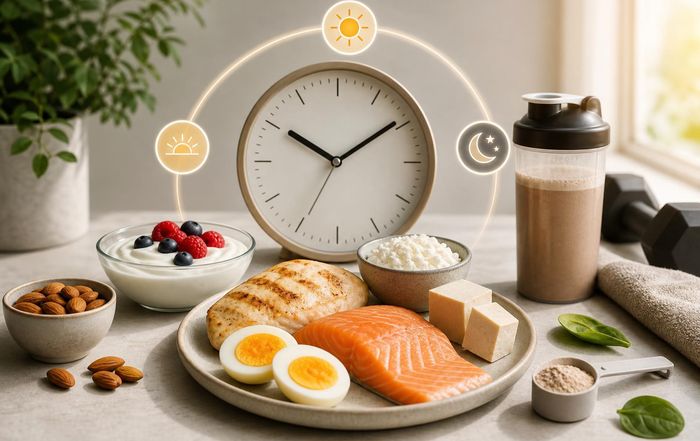
Protein Timing: What Really Matters for Everyday Health
For professional athletes, the details of when to drink a protein shake can be a serious topic of debate. For everyone else trying to feel stronger, manage weight, or age well, the question is simpler but still important: does protein timing actually matter, or is total protein intake throughout the day what really counts?
Current research suggests both are relevant-but not in the way many marketing slogans imply. For most people, how much protein you eat across the day is the main priority, and how you spread it out is a useful second step. The idea of a narrow "anabolic window" right after exercise, while not completely wrong, is often overstated.
This food focused article unpacks what science says about protein timing, how it affects muscle, metabolism, appetite, and aging, and how to use these insights in a practical, low-stress way for everyday life.
Why protein matters more than timing (but timing still helps)
Protein is central to many wellness goals: maintaining muscle, supporting immune function, managing appetite, and recovering from workouts. The first question is not "when" but "how much."
Organizations such as the World Health Organization and many national health agencies set a minimum daily protein intake of around 0.8 g per kilogram of body weight for adults, primarily to prevent deficiency. However, numerous studies summarized by groups like the International Society of Sports Nutrition and researchers at institutions such as Harvard T.H. Chan School of Public Health suggest that higher intakes-typically in the range of 1.2-1.6 g/kg/day-are often more appropriate for people who are physically active, trying to lose fat while preserving muscle, or aiming to age well with good functional strength.
For someone weighing 70 kg (about 154 pounds), that often translates to 85-110 grams of protein per day. This range is not a strict rule but a reasonable target for many healthy adults. Within that total, distributing protein across meals-rather than eating most of it at dinner-seems to support muscle protein synthesis (the building and repair of muscle) more effectively.
In other words, timing is best understood as distribution across the day, not as a single magic moment. For active readers interested in broader nutrition and lifestyle context, our wellness and health sections explore how diet fits into holistic self-care.
The "anabolic window" after exercise: myth, nuance, and reality
The popular idea of a strict 30-minute "anabolic window" after training-during which you must consume protein or "waste" your workout-is oversimplified. Early research, often done in fasted conditions, suggested that consuming protein immediately after resistance exercise could significantly enhance muscle protein synthesis. However, more recent work, including reviews cited by the American College of Sports Medicine and Examine (an evidence-focused nutrition resource), indicates that the window is broader and more flexible than once thought.
If you ate a protein-containing meal within a couple of hours before training, amino acids are still circulating in your system well after your workout ends. In this scenario, having protein within roughly 2 hours after exercise is beneficial but not urgent. If you trained fasted (for example, early in the morning before breakfast), then having protein relatively soon afterward becomes more important because your body has fewer circulating amino acids to draw from.
Rather than a strict 30-minute sprint, it is more accurate to view the post-exercise period as a multi-hour opportunity where protein helps your body repair and adapt. For most people with everyday fitness goals, hitting their total daily protein intake and including some protein within a few hours before and after training is sufficient. Those training at a higher level or with specific performance goals may want more precise strategies, which we often explore in our fitness coverage.
Spreading protein across the day: why 3-4 "hits" often beat one big meal
Beyond total intake, distribution matters because the body responds to each "dose" of protein with a rise in muscle protein synthesis, especially when that dose contains enough of the amino acid leucine. Research from groups such as McMaster University and other exercise physiology labs suggests that for many adults, a per-meal dose of around 20-40 grams of high-quality protein is sufficient to maximize this response, depending on body size, age, and training status.
When protein is heavily skewed to a single meal-often dinner-breakfast and lunch may not reach the threshold needed to fully stimulate muscle-building processes. For example, a typical pattern might be 10 g at breakfast, 15 g at lunch, and 60 g at dinner. Total intake might be adequate, but two of those meals may be suboptimal from a muscle perspective.
By contrast, eating something like 25-35 grams of protein at three or four meals or snacks (for example, breakfast, lunch, dinner, and an evening snack) appears to support more consistent muscle protein synthesis across the day. This pattern is particularly relevant for:
People doing resistance or strength training several times a week
Adults over 50, who experience "anabolic resistance" and may need slightly higher per-meal doses
Individuals trying to lose body fat without losing muscle mass
This distribution approach also tends to improve satiety and may help with appetite management, a topic frequently discussed by public health agencies like the National Institutes of Health and NHS in the UK. For readers looking to integrate this with mindful eating habits, our mindfulness section offers complementary strategies around awareness, hunger cues, and emotional eating.
Morning, evening, or workout-adjacent? How timing fits different lifestyles
For everyday health, the best timing strategy is the one that fits consistently into your routine. Still, there are some patterns supported by research and practice.
A higher-protein breakfast has been associated with improved satiety, reduced snacking later in the day, and better blood sugar control in some people. Studies referenced by organizations like the American Diabetes Association and Academy of Nutrition and Dietetics highlight how protein, alongside fiber and healthy fats, can slow digestion and blunt sharp glucose spikes. For those who typically skip breakfast or rely on refined carbohydrates, simply adding a moderate protein source-such as eggs, Greek yogurt, tofu, or a protein smoothie-can be a meaningful shift.
Around exercise, many sports nutrition guidelines suggest consuming a protein-rich meal within 2-3 hours before training and another within 2-3 hours afterward. Whether this is a full meal or a snack can depend on your schedule, digestion, and personal preference. The goal is not a rigid schedule but ensuring your muscles have access to amino acids before and after being challenged.
Evening protein can also play a role. For people who train later in the day, a balanced dinner with adequate protein is naturally helpful. Some research, including work cited by the International Society of Sports Nutrition, has explored pre-sleep protein (for example, casein) to support overnight muscle repair, particularly in athletes. For the average person, the practical takeaway is simpler: if total daily protein is low, adding some in the evening can help you reach your target and support recovery.
These timing ideas can be integrated into broader lifestyle changes-such as improving sleep, movement, and stress management-which we regularly cover in our lifestyle and wellness articles.
Protein timing for different goals: strength, weight, and healthy aging
The importance of timing can shift depending on what you are trying to achieve. Three common goals-strength and performance, weight management, and healthy aging-illustrate how.
For strength and performance, total daily protein is foundational, but timing around training becomes more relevant as training volume and intensity increase. Athletes and serious lifters often aim for 1.6-2.2 g/kg/day, with 3-5 protein-rich meals or snacks spaced roughly every 3-4 hours while awake. Organizations such as the International Olympic Committee and American College of Sports Medicine emphasize this pattern in their consensus statements. In this context, ensuring a protein-containing meal or shake within a couple of hours pre- and post-workout is a low-friction way to support adaptation.
For weight management, protein's timing impact is often linked to appetite, cravings, and energy. Higher-protein meals-especially earlier in the day-can help reduce late-night snacking for some people. A protein-forward breakfast and lunch, combined with a balanced dinner, may make it easier to maintain a calorie deficit without feeling deprived. Here, timing is more about behavior and hunger patterns than muscle physiology, but it is still meaningful.
For healthy aging, protein timing becomes particularly important due to age-related muscle loss (sarcopenia). Research summarized by bodies such as Age UK, NIH, and various gerontology societies suggests older adults may benefit from slightly higher daily protein intakes (often at least 1.0-1.2 g/kg/day, sometimes more if active and medically appropriate) and from distributing that protein evenly across meals. Instead of a very light breakfast and a protein-heavy dinner, three or four meals with 25-35 grams of protein each can help preserve strength, balance, and independence. This intersects closely with broader health and world discussions about aging populations and functional longevity.
Whole foods vs. shakes: does form matter for timing?
Protein shakes and bars are often marketed as timing tools-especially for post-workout recovery. They can be useful, but they are not mandatory for most people. From a timing perspective, the body primarily "cares" about the amino acids themselves, not whether they came from a chicken breast, lentil stew, tofu, yogurt, or a whey shake.
Whole-food protein sources-such as legumes, fish, eggs, dairy, soy, nuts, seeds, and lean meats-bring additional nutrients: fiber, healthy fats, vitamins, and minerals. Many public health organizations, including the World Health Organization and Harvard T.H. Chan School of Public Health, encourage obtaining most protein from minimally processed foods. Plant-based proteins can absolutely support muscle and health when total intake and variety are adequate, a topic we often revisit in our environment and brands coverage when assessing sustainability and product claims.
Protein powders can be convenient when appetite is low, time is tight, or you train very early or late. They can also help some people meet higher protein targets, especially in contexts such as intensive training, recovery from illness, or specific medical recommendations. The key is to view supplements as optional tools that support a well-structured eating pattern, rather than as magic timing solutions.
How much protein per meal? Practical ranges, not rigid rules
While individual needs vary, several patterns emerge across studies and position stands from organizations like the International Society of Sports Nutrition, American College of Sports Medicine, and Academy of Nutrition and Dietetics:
For many adults, around 20-40 grams of high-quality protein per meal appears to maximize the muscle protein synthesis response, with smaller amounts still beneficial but potentially less efficient.
Smaller individuals or those with lower activity levels may be toward the lower end; larger or more active individuals, and older adults, may need closer to the upper end to achieve a similar effect.
Spacing these meals every 3-4 hours during waking time provides multiple "opportunities" for muscle repair and remodeling.
In real food terms, this might look like Greek yogurt with nuts and fruit, eggs with whole grains, lentil or bean-based dishes, tofu stir-fries, or fish and vegetables. For those who enjoy exploring food cultures while traveling, many traditional diets naturally combine protein with plant foods-something we often highlight in our travel and world reporting on regional cuisines.
Importantly, these are guidelines, not strict prescriptions. Someone eating 18 grams at breakfast and 32 at lunch is not missing out in a meaningful way compared with 25 and 25. The aim is to avoid chronically low-protein meals and the pattern of "tiny protein, tiny protein, giant protein," rather than to micromanage every gram.
Special situations: fasting, plant-based diets, and busy schedules
Protein timing questions often arise in specific contexts where routines are constrained or preferences are strong.
Intermittent fasting or time-restricted eating compresses the eating window, which can make it harder to distribute protein evenly. In an 8-hour eating window, for example, it may still be possible to have three protein-rich meals or two meals and a snack, but each will need enough protein to reach your daily target. Organizations like the National Institutes of Health and major academic centers note that while intermittent fasting can work for some people, its success often depends on the quality and composition of the food eaten during the feeding window. Ensuring adequate protein at each eating opportunity becomes particularly important.
Plant-based diets can absolutely support strength and health, but protein timing and variety matter. Combining different plant proteins across the day-such as beans, lentils, whole grains, soy, nuts, and seeds-helps ensure a broad amino acid profile. Some individuals may find it easier to reach per-meal protein targets by including more concentrated sources like tofu, tempeh, seitan, or plant-based protein powders. Resources from groups such as the Academy of Nutrition and Dietetics and Harvard T.H. Chan School of Public Health emphasize that attention to total protein and key nutrients (like iron, B12, and omega-3s) is more important than any single timing trick.
For people with very busy schedules, the most realistic approach is often to identify "anchor points": a protein-rich breakfast, a prepared lunch (or reliable option near work), and a simple, repeatable dinner structure. Snacks-such as yogurt, nuts, edamame, or a small shake-can fill gaps as needed. Here, timing is about building routines that remove friction, which is a recurring theme in our business and jobs coverage on workplace wellbeing.
Health risks, safety, and when to be cautious
For healthy individuals with normal kidney function, protein intakes in the ranges discussed above (roughly 1.2-1.6 g/kg/day, sometimes higher for athletes) are generally considered safe by many expert groups, including the International Society of Sports Nutrition and various nephrology organizations. However, people with existing kidney disease, certain metabolic conditions, or complex medical histories should not significantly increase protein intake-or change timing patterns that affect medication or blood sugar-without guidance from a healthcare professional.
Public health agencies such as the National Kidney Foundation and NHS emphasize that those with impaired kidney function may need to limit protein to reduce the burden on the kidneys. In such cases, timing might still be used strategically-spreading a medically appropriate total across the day-but only under professional supervision. Similarly, individuals with diabetes or other metabolic conditions should consider how protein timing interacts with carbohydrate intake, medications, and blood glucose monitoring.
For the general population, the bigger risks are usually not from "too much" protein within normal ranges, but from neglecting other aspects of diet and lifestyle. Focusing heavily on protein timing while ignoring fiber, fruits and vegetables, healthy fats, movement, sleep, and stress can create an illusion of optimization without meaningful health gains. Our wise wellness and original innovation reporting often explores how to balance enthusiasm for new nutrition trends with a grounded view of overall lifestyle.
Putting it all together: a low-stress approach to protein timing
For everyday health, the most practical way to think about protein timing is as a simple hierarchy of priorities:
Ensure total daily protein is adequate for your body size, activity level, and goals. For many active adults, that might be somewhere around 1.2-1.6 g/kg/day, adjusted with professional advice if you have medical conditions.
Distribute protein across 3-4 meals or snacks, aiming for roughly 20-40 grams at each, rather than concentrating most of it in a single meal.
Around exercise, try to have a protein-containing meal or snack within a few hours before and after training, without obsessing over a narrow window.
Choose mostly whole-food protein sources, using shakes or bars as convenient tools rather than necessities.
Adapt timing to your real life-work, family, travel, and preferences-so that your pattern is sustainable, not perfect on paper but impossible in practice.
Protein timing is not a magic lever that overrides sleep, movement, or mental health, but it is a useful, manageable detail once the fundamentals are in place. Approached with flexibility rather than rigidity, it can support strength, energy, and resilience at every stage of life.