

Coastal Walking in Norway: How to Plan Your First Route
Norway's coastline is one of the most dramatic in the world: thousands of kilometers of fjords, islands, white-sand coves, fishing villages, and polished rock shelves that meet the sea. For many visitors, the challenge is not whether to go, but how to turn this vast, varied shoreline into a manageable first coastal walking trip. Between the famous Lofoten islands, the fjords of Western Norway, and quieter stretches of the south and north, it can be hard to know where to begin, what's realistic for your fitness level, and how to stay safe in a maritime climate that can change in minutes.
This peaceful guide focuses on practical planning for a first-time coastal walking route in Norway. It looks at how to choose a region, read the terrain and weather, find and follow trails, and balance physical challenge with rest, food, and recovery so that the trip supports overall wellness rather than becoming an exhausting endurance test. It also highlights safety and environmental considerations that matter along an often-fragile shoreline.
Choosing the right coastal region for a first trip
Norway's coast is long enough to offer very different experiences depending on where you go, and that choice will shape everything from your daily distances to your budget. For a first trip, it helps to think in terms of broad regions, each with its own character, infrastructure, and difficulty level, and then narrow down to a specific base or multi-day route.
The Oslofjord and Southern Coast ("Sørlandet") are often the most approachable for beginners. Around towns like Kristiansand, Arendal, and Grimstad, you'll find well-marked coastal paths, sheltered archipelagos, and relatively gentle terrain, with plenty of beaches and small harbors. Public transport is fairly frequent, which makes it easy to walk point-to-point sections and take a bus or boat back. These areas suit travelers who want relaxed daily distances, café stops, and a strong holiday atmosphere in summer. They're also a good option for families or those focusing on wellness and gentle activity rather than strenuous hiking.
Western Norway, including Stavanger, Bergen, and the fjord areas, offers a mix of coastal promenades and more rugged shoreline hikes. Around Stavanger, the Jæren coastline has long sandy beaches and dunes that can be walked in stages, with villages and farm stays along the way. Closer to the major fjords, the "coast" may mean narrow roads and paths that cling to steep hillsides above deep water, with short but steep climbs, tunnels, and ferries. This region suits walkers who want a blend of culture, dramatic scenery, and moderate challenge, and who are comfortable with some elevation changes and variable weather.
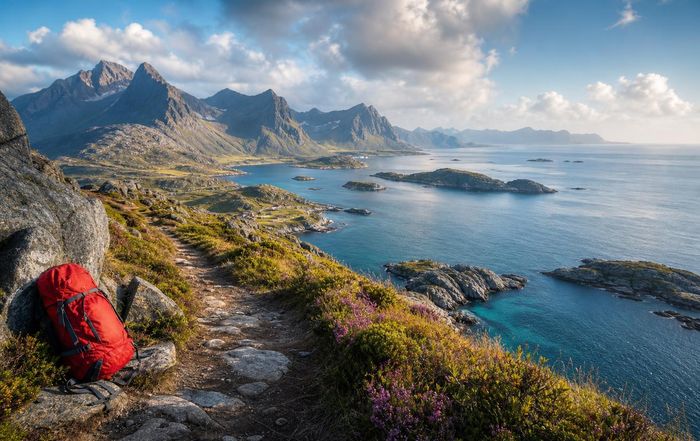
Further north, Lofoten, Vesterålen, and the Helgeland coast are the dream destinations many people picture when they think of Norwegian coastal walking: mountains rising straight from the sea, white-sand arctic beaches, and fishing villages set beneath towering cliffs. These areas are spectacular, but they can be exposed, with rougher weather, fewer services, and some trails that are eroding under heavy use. For a first trip, they are best approached with realistic expectations: shorter stages, rest days, and careful route selection. The Norwegian Trekking Association (Den Norske Turistforening, or DNT) provides useful regional overviews and maps through its website at https://www.dnt.no/.
The far north, including Finnmark and the Arctic coast, offers wild, open landscapes and a strong sense of remoteness, but infrastructure is sparse and conditions can be harsh even in summer. For a first-time coastal walker, this area is generally better left until you have more experience with Norwegian terrain and logistics. Wherever you go, it is wise to cross-check your ideas with regional tourist boards such as Visit Norway at https://www.visitnorway.com/, which provide up-to-date information on trails, seasonal access, and local transport.
Understanding Norwegian coastal terrain and difficulty
Coastal walking in Norway is not always the gentle seafront promenade that some might imagine from Mediterranean destinations. Even when trails are close to sea level, they can be surprisingly demanding due to uneven ground, wet rocks, boggy sections, and frequent short climbs and descents. Assessing difficulty honestly is essential for both safety and enjoyment, especially if your primary goal is wellbeing rather than pure adventure.
Many coastal routes mix several surfaces in a single day: gravel tracks, forest paths, boardwalks, sandy beaches, rock slabs, and occasional road sections. Wet rock and seaweed can be extremely slippery, particularly after rain or when waves have washed over the shoreline. Some popular spots in Lofoten and Western Norway have experienced erosion and muddy sections due to overuse, which can slow progress and require careful foot placement. Walking poles can make a significant difference to stability on such terrain, especially when carrying a pack.
Norway does not have a single nationwide difficulty rating system for all trails, but DNT commonly uses a color code (green, blue, red, black) to indicate increasing challenge, similar to ski runs. Coastal walks around tourist towns are often green or blue, while more remote or steep routes may be red or black. It is important to understand that "blue" in a Norwegian context can still feel challenging if you are used only to flat urban walking. When in doubt, start easier than you think you need and adjust upward once you have a feel for local conditions.
Elevation profiles can also be deceptive. A route that never goes above 200 meters can still accumulate 600-800 meters of ascent through constant rolling ups and downs. That can be tiring if you plan several consecutive days. Online mapping tools such as https://www.norgeskart.no/ and commercial apps that use official Norwegian map data are invaluable for previewing terrain, contour lines, and the proximity of escape options such as roads or bus stops. For wellness-focused travelers, combining one more demanding day with one or two easier coastal strolls can be a balanced way to experience the landscape without overloading the body.
Weather, seasons, and daylight along the Norwegian coast
The maritime climate is one of the defining features of coastal walking in Norway. Weather can change quickly, and conditions vary significantly between south and north, as well as between exposed headlands and sheltered fjords. Planning your route means planning for the sky above as much as the ground beneath your feet.
Summer, broadly from June to August, is the most popular season, with milder temperatures and long days. In northern regions, the midnight sun allows extended daylight, which can be both a gift and a trap: it is easy to keep walking far beyond your planned distance simply because it never gets dark, leading to fatigue. In the south, days are long but nights still fall, and coastal temperatures are often comfortable for walking, though heatwaves have become more frequent in recent years. The Norwegian Meteorological Institute provides detailed, localized forecasts through https://www.yr.no/, which is widely used by locals and visitors alike.
Spring and autumn offer quieter trails and often beautiful, crisp conditions, but they also bring more unpredictability: stronger winds, more frequent rain, and, in northern or higher areas, the possibility of snow or icy patches. On exposed headlands, wind chill can be significant even when the air temperature seems moderate. Waterproofs and windproof layers are essential in all seasons, as is a dry bag or liner to protect spare clothing in your pack. The Norwegian Directorate for Civil Protection offers general outdoor safety guidance at https://www.dsb.no/, including information about coastal and weather-related hazards.
Winter coastal walking is possible in some southern and urban areas, but it demands special caution due to ice, storms, and short daylight hours. For a first-time visitor focused on walking for health and enjoyment, winter is generally not the ideal season to plan a multi-day coastal route unless you are experienced with Nordic conditions and have appropriate gear. When planning, it is wise to build flexibility into your itinerary-shorter stages that can be combined or split, rest days that can be used as weather buffers, and backup activities in case a storm keeps you off exposed paths.
Where to base yourself: hubs, accommodation, and transport
A key decision for first-time coastal walkers is whether to choose a single base and do day walks, or to plan a point-to-point route with different overnight stops. Both approaches can work well in Norway, and the right choice depends on your comfort with logistics, your fitness, and whether you are traveling alone or in a group.
Base-based walking, where you stay several nights in one town or village and explore different coastal sections each day, reduces packing and planning stress. Towns like Stavanger, Bergen, Ålesund, Bodø, Svolvær in Lofoten, and seaside towns in Sørlandet have a range of hotels, guesthouses, and apartments, as well as restaurants and supermarkets. From these hubs, local buses or boats can take you to trailheads, and you can return "home" each evening. This style of trip fits well with a broader lifestyle and travel focus, combining walking with culture, food, and time to rest.
Point-to-point walking, where you move along the coast and sleep in different places, offers a stronger sense of journey and immersion. In Norway, this might mean a mix of small hotels, cabins, campsites, or, in some regions, DNT huts. However, the coast is not lined with accommodation at regular intervals, so careful planning is needed to match daily distances with available beds or safe camping spots. The national rail operator https://www.vy.no/ and local bus companies can help you link sections and return to your starting point at the end of the trip.
Ferries are an integral part of Norwegian coastal travel. On some routes, especially in fjord regions and the north, you may need to coordinate walks with ferry timetables. The iconic Hurtigruten coastal voyage, at https://www.hurtigruten.com/, functions as both a cruise and a working coastal service, allowing some travelers to combine ship segments with shore-based walking. For those interested in blending walking with world and environment perspectives, this can provide a unique view of coastal communities and marine ecosystems.
If you plan to camp, remember that Norway's right to roam (allemannsretten) allows responsible wild camping, but with important conditions: you must stay a certain distance from houses, avoid cultivated land, and respect local regulations. Coastal dunes, bird nesting areas, and fragile vegetation may have additional restrictions. The Norwegian Environment Agency, via https://www.miljodirektoratet.no/, provides guidance on protected areas and outdoor ethics.
Mapping, navigation, and finding coastal trails
Norway has a strong outdoor culture, and many coastal paths are well-marked, but it is still unwise to rely solely on signposts or a phone with patchy reception. Good maps and basic navigation skills are an important part of planning your first route, particularly if you want to venture beyond the most popular promenades.
Official topographic maps can be accessed digitally through Norgeskart at https://www.norgeskart.no/, where you can zoom from national to local level and identify paths, contour lines, and shoreline features. Printed maps are available in bookstores and tourist offices, which can be reassuring as a backup. DNT's website, https://www.dnt.no/, lists many of its marked routes and cabins, though not all coastal paths are DNT-maintained; some are created and managed by municipalities or local associations.
Popular commercial navigation apps can be useful, but always verify that they use up-to-date Norwegian map data and do not simply rely on crowd-sourced GPX tracks, which may be inaccurate or cross sensitive terrain. For coastal walking, pay special attention to whether a path is actually above the high-tide line, whether it crosses private land, and whether there are safe crossing points at inlets or rivers. In some areas, what looks like a "shortcut" along the beach may be cut off at high tide or require scrambling over slippery rocks.
When planning, identify clear start and end points for each day-such as a bus stop, ferry landing, or recognizable landmark-and note alternative exit points in case of bad weather or fatigue. Tourist information centers, often found in coastal towns, can provide local trail leaflets and up-to-date advice on closures or diversions. For those interested in mindful walking and mental wellbeing, having a solid navigation plan also reduces background stress, allowing more attention to the sensory experience of sea, light, and landscape-an aspect closely aligned with mindfulness practices.
Packing for coastal conditions: clothing, gear, and comfort
Packing for Norway's coast means preparing for sunshine, wind, rain, and cool temperatures, sometimes all in one day. The goal is not to carry everything imaginable, but to assemble a flexible, layered system that keeps you comfortable and safe while supporting the restorative aspects of being outdoors.
A typical clothing system includes a moisture-wicking base layer, an insulating mid-layer (such as a fleece or light wool), and a waterproof, windproof outer shell. Even in summer, a hat and gloves can be welcome on exposed stretches or during boat crossings. Quick-drying trousers or shorts are preferable to heavy cotton, which can stay wet and sap warmth. Footwear is particularly important: lightweight hiking boots or sturdy trail shoes with good grip are usually better than casual sneakers, especially on wet rock or uneven ground. If you plan to walk along sandy beaches for long distances, some prefer shoes that drain well and dry quickly.
A small to medium-sized backpack (20-30 liters for day walks) allows space for extra layers, water, snacks, and safety items. A simple first aid kit, blister care, and any personal medications are essential. In Norway's maritime climate, a waterproof pack cover or dry bags inside your pack can prevent clothing and electronics from becoming soaked. For wellness-oriented travelers, items like a compact sit mat, a light towel, or a notebook for reflections can enhance the restorative quality of breaks by the sea, tying the trip into broader health and lifestyle goals.
Sun protection is often overlooked in cooler climates, but reflection from water and pale rock can increase UV exposure. Sunglasses, a sun hat, and sunscreen are important, especially in the long days of northern summer. Insect repellent may be useful in some sheltered, vegetated coastal areas, though wind-exposed headlands tend to have fewer insects. Trekking poles, while not strictly necessary, can reduce strain on knees and hips, distribute effort more evenly, and improve balance on slippery surfaces, which is particularly helpful for those combining walking with a broader fitness or rehabilitation program.
Safety, tides, and respect for the sea
Norway's coastline is beautiful but powerful. Even experienced walkers can underestimate the risks posed by waves, tides, and sudden weather changes. A cautious approach is not about fear; it is about creating the conditions for a calm, enjoyable experience that supports both physical and mental wellbeing.
The Norwegian authorities emphasize staying well back from the water's edge on exposed headlands, particularly during storms or when large swell is forecast. "Sneaker waves" can surge farther up rocks than expected, and wet stone can be extremely slippery. While Norway does not have the large tidal ranges seen in some parts of the world, local variations and narrow inlets can still create strong currents and rapidly changing water levels. If a route description or local advice mentions that a beach or rock section is only passable at low tide, treat that seriously and confirm timing locally.
Before each walking day, check the local weather forecast via https://www.yr.no/ or other trusted sources, and be prepared to change or shorten your plans. In case of emergencies, Norway's general emergency number is 112, and mountain or outdoor rescue services are well organized. The Norwegian Red Cross, at https://www.rodekors.no/, is involved in many rescue operations and provides safety information for outdoor activities. Carrying a fully charged phone, a power bank, and knowing your approximate location (for example, by noting nearby place names on a map) can significantly speed up help if needed.
Respecting the sea also means respecting its ecosystems. Rocky shorelines, tidal pools, and seabird colonies are sensitive environments. Many areas are protected, particularly important nesting cliffs and marine reserves, and may have seasonal access restrictions. The Norwegian Environment Agency at https://www.miljodirektoratet.no/ outlines rules for national parks and other protected zones. Staying on established paths where they exist, avoiding disturbance of wildlife, and packing out all litter-including food scraps-are simple but important ways to reduce impact.
Wellness, pacing, and recovery on a coastal walking holiday
Coastal walking in Norway lends itself naturally to a wellness-focused approach: the sound of waves, the play of light on water, and the slower rhythm of small coastal communities can all support mental and physical reset. Yet it is easy to turn even a beautiful route into a stressful race if daily distances are too long or expectations are unrealistic. Thoughtful pacing can make the difference between a trip that depletes and one that restores.
For a first coastal walking holiday, many people find that 10-18 kilometers per day on Norwegian terrain is plenty, especially when paths are uneven or include short climbs. Rest breaks-whether to stretch, eat, or simply sit and watch the sea-are not time "lost" but integral to the experience. Integrating simple mindfulness techniques, such as focusing on breath while walking or taking a few minutes at viewpoints to notice sounds and sensations, can deepen the benefits. Readers interested in the mental health dimensions of time outdoors can find broader context in resources from the World Health Organization at https://www.who.int/ and national health bodies like Helsedirektoratet at https://www.helsedirektoratet.no/.
Nutrition and hydration are also part of recovery. Coastal air can be drying, and cooler temperatures may mask thirst. Carrying water and light, energy-dense snacks helps maintain stable energy levels and mood. In small coastal communities, shops and cafés may have limited opening hours, especially outside peak summer, so checking ahead and carrying backup food is wise. In the evenings, gentle stretching, a warm shower, or, where available, a sauna or spa treatment can aid muscle recovery and relaxation, tying the trip into a broader health and beauty or massage routine.
Sleep is another crucial component. Long daylight hours in northern Norway can make it harder to wind down; eye masks or blackout curtains can help maintain a regular sleep pattern. If you are traveling with others, aligning expectations around start times, pace, and rest days before the trip can reduce friction and support a more harmonious, restorative experience for everyone.
Environmental responsibility and local culture along the coast
Norway's coastal landscapes are not only natural environments but also cultural spaces shaped by fishing, farming, shipping, and, increasingly, tourism. Walking thoughtfully means recognizing that trails often pass close to people's homes, workplaces, and heritage sites, and that your presence has both economic and environmental impacts.
The right to roam gives broad access to nature but is grounded in the principle of "leave no trace" and respect for property. This means closing gates, not crossing cultivated fields during the growing season, keeping a respectful distance from houses and cabins, and being discreet when stopping for breaks. In fishing villages and small harbors, piers and working areas may be unsafe or off-limits; obeying local signs helps maintain good relations between visitors and residents. Local tourist boards and municipal websites, often linked from https://www.visitnorway.com/, provide guidance on etiquette and access in specific areas.
Environmental concerns along the coast include plastic pollution, disturbance of birdlife, and pressure on fragile vegetation from increasing foot traffic. Some municipalities and volunteer groups organize beach clean-ups or maintain boardwalks to protect dunes and wetlands. Joining or supporting such initiatives, even informally by picking up a few pieces of litter during your walk, can be a meaningful way to give back. Organizations like Friends of the Earth Norway at https://www.naturvernforbundet.no/ advocate for coastal and marine protection and offer insights into current environmental challenges.
Engaging with local culture can also enrich the experience: visiting small museums, trying regional seafood, or learning about the history of cod fishing, shipping, and coastal lighthouses. Many coastal communities are experimenting with sustainable tourism models that balance economic opportunity with conservation. Choosing locally owned accommodation and services where possible supports these efforts and helps ensure that the coastal paths you enjoy remain well cared for.
Turning inspiration into an achievable first route
Planning a first coastal walking route in Norway can feel daunting given the sheer variety of options, but breaking the process into a few key decisions makes it more manageable. Start by choosing a region that matches your comfort level and interests, whether that is the gentle archipelagos of the south, the fjord-fringed west, or a carefully chosen part of the north. Then, define a realistic daily distance range, taking into account Norwegian terrain and your own fitness, and map out stages that connect clear start and end points via established paths.
Build in flexibility for weather, rest, and curiosity-days that can be shortened, alternative low-level routes, and time to linger in places that speak to you. Equip yourself with appropriate clothing, navigation tools, and a basic understanding of coastal safety and environmental responsibility. Finally, hold onto the reason you were drawn to Norway's coast in the first place: whether it is the promise of wide horizons, the rhythm of waves, or a desire to reset your relationship with movement and nature.
We’re glad you stayed with the story. Keep exploring the subjects that matter to you and continue looking for perspectives that add genuine value. With thoughtful planning, coastal walking in Norway can be more than a scenic holiday. It can become a meaningful part of a broader commitment to health, mindfulness, and sustainable living-one step at a time along the edge of the sea.